
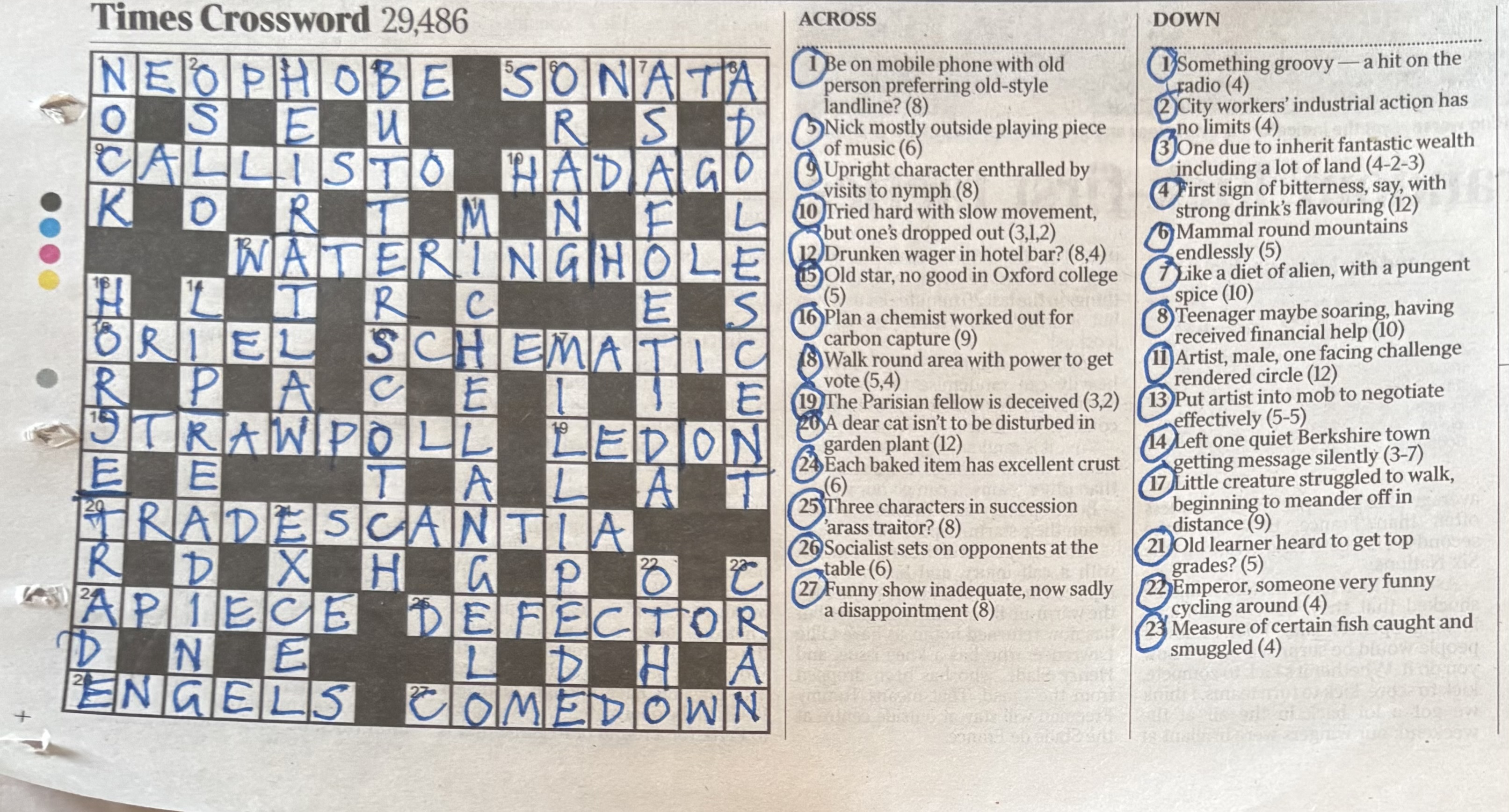
Pleasing
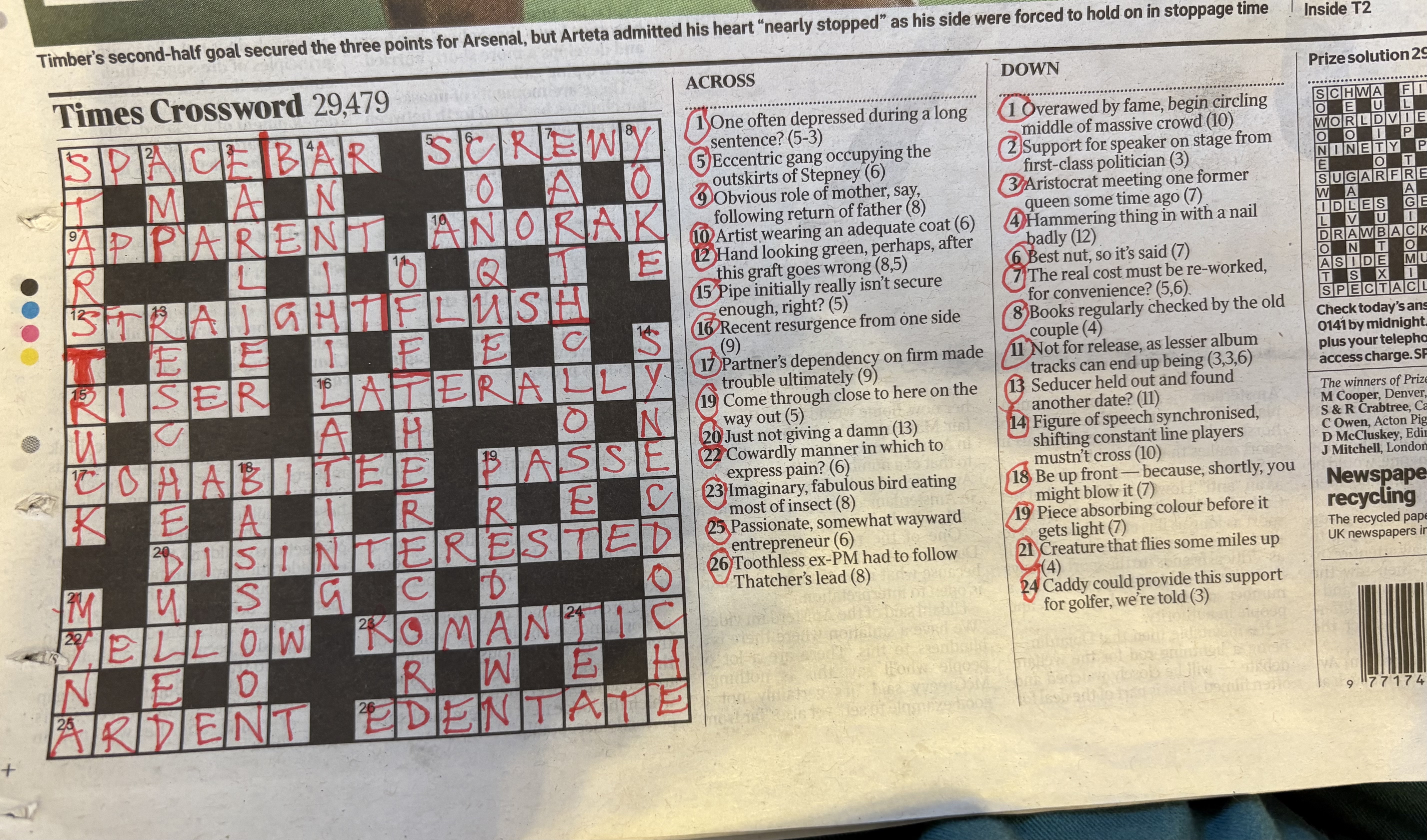
I enjoy the way in which clues that initially look opaque become clearer and clearer with scrutiny, until everything falls into place. LJ
L’isolement (Alphonse de Lamartine)
Souvent sur la montagne, à l’ombre du vieux chêne,
Au coucher du soleil, tristement je m’assieds ;
Je promène au hasard mes regards sur la plaine,
Dont le tableau changeant se déroule à mes pieds.
Ici, gronde le fleuve aux vagues écumantes ;
Il serpente, et s’enfonce en un lointain obscur ;
Là, le lac immobile étend ses eaux dormantes
Où l’étoile du soir se lève dans l’azur.
Au sommet de ces monts couronnés de bois sombres,
Le crépuscule encor jette un dernier rayon,
Et le char vaporeux de la reine des ombres
Monte, et blanchit déjà les bords de l’horizon.
Cependant, s’élançant de la flèche gothique,
Un son religieux se répand dans les airs,
Le voyageur s’arrête, et la cloche rustique
Aux derniers bruits du jour mêle de saints concerts.
Mais à ces doux tableaux mon âme indifférente
N’éprouve devant eux ni charme ni transports,
Je contemple la terre ainsi qu’une ombre errante :
Le soleil des vivants n’échauffe plus les morts.
De colline en colline en vain portant ma vue,
Du sud à l’aquilon, de l’aurore au couchant,
Je parcours tous les points de l’immense étendue,
Et je dis : « Nulle part le bonheur ne m’attend. »
Que me font ces vallons, ces palais, ces chaumières,
Vains objets dont pour moi le charme est envolé ?
Fleuves, rochers, forêts, solitudes si chères,
Un seul être vous manque, et tout est dépeuplé.
Que le tour du soleil ou commence ou s’achève,
D’un oeil indifférent je le suis dans son cours ;
En un ciel sombre ou pur qu’il se couche ou se lève,
Qu’importe le soleil ? je n’attends rien des jours.
Quand je pourrais le suivre en sa vaste carrière,
Mes yeux verraient partout le vide et les déserts ;
Je ne désire rien de tout ce qu’il éclaire,
Je ne demande rien à l’immense univers.
Mais peut-être au-delà des bornes de sa sphère,
Lieux où le vrai soleil éclaire d’autres cieux,
Si je pouvais laisser ma dépouille à la terre,
Ce que j’ai tant rêvé paraîtrait à mes yeux !
Là, je m’enivrerais à la source où j’aspire ;
Là, je retrouverais et l’espoir et l’amour,
Et ce bien idéal que toute âme désire,
Et qui n’a pas de nom au terrestre séjour !
Que ne puis-je, porté sur le char de l’Aurore,
Vague objet de mes vœux, m’élancer jusqu’à toi !
Sur la terre d’exil pourquoi restè-je encore ?
Il n’est rien de commun entre la terre et moi.
Quand la feuille des bois tombe dans la prairie,
Le vent du soir s’élève et l’arrache aux vallons ;
Et moi, je suis semblable à la feuille flétrie :
Emportez-moi comme elle, orageux aquilons !
Alphonse de Lamartine, Méditations poétiques
Goofiness … (satisfying, on the whole)
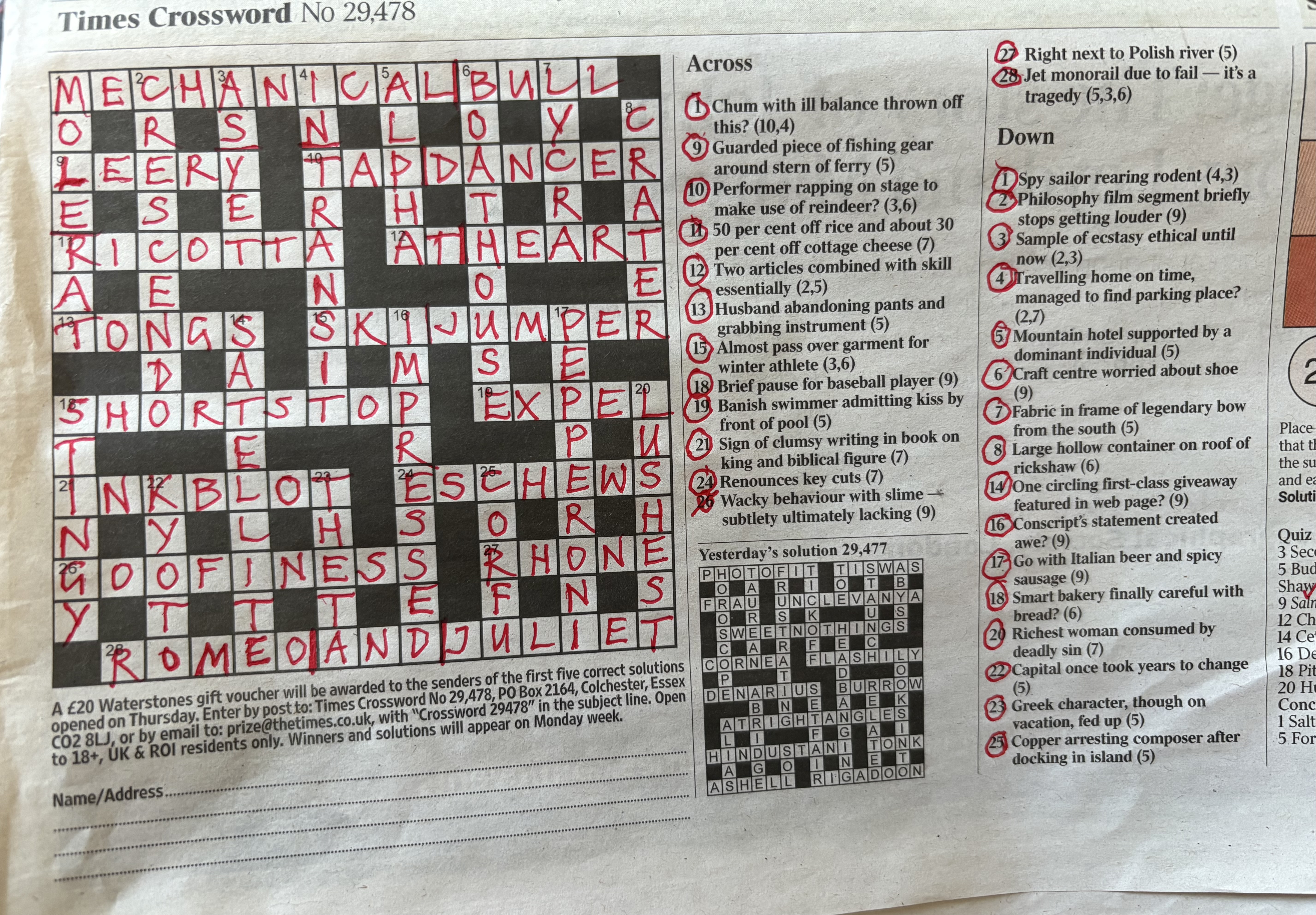
Very satisfying
Shoelace took me ages!
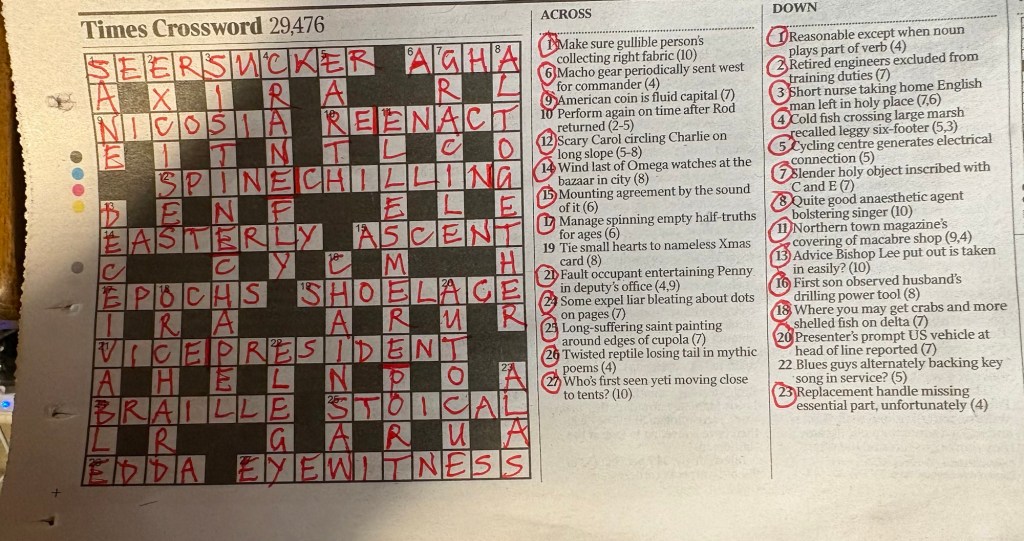
Phew! A couple of stubborn ones, but I got there!
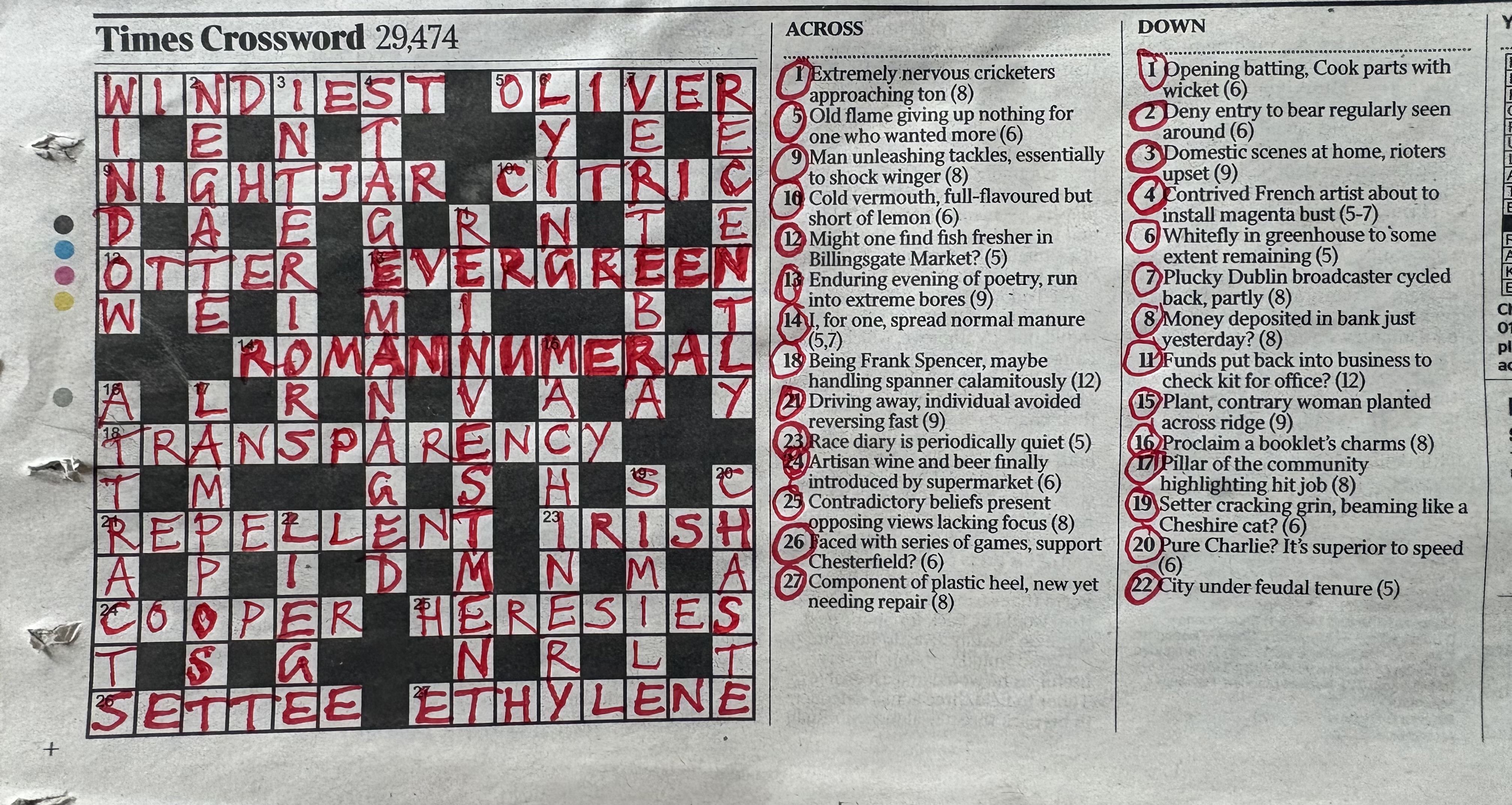
Rake
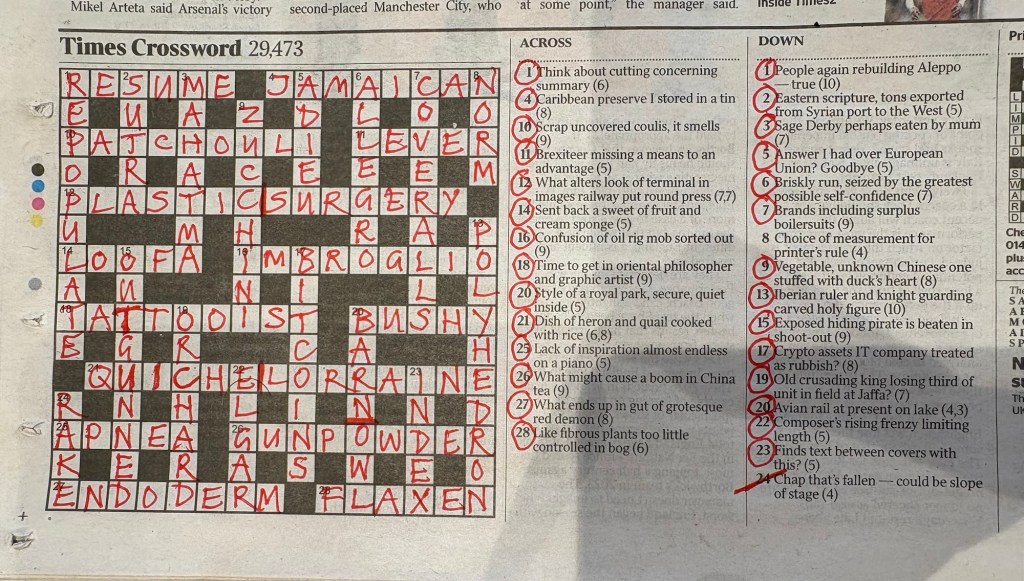
Satisfying
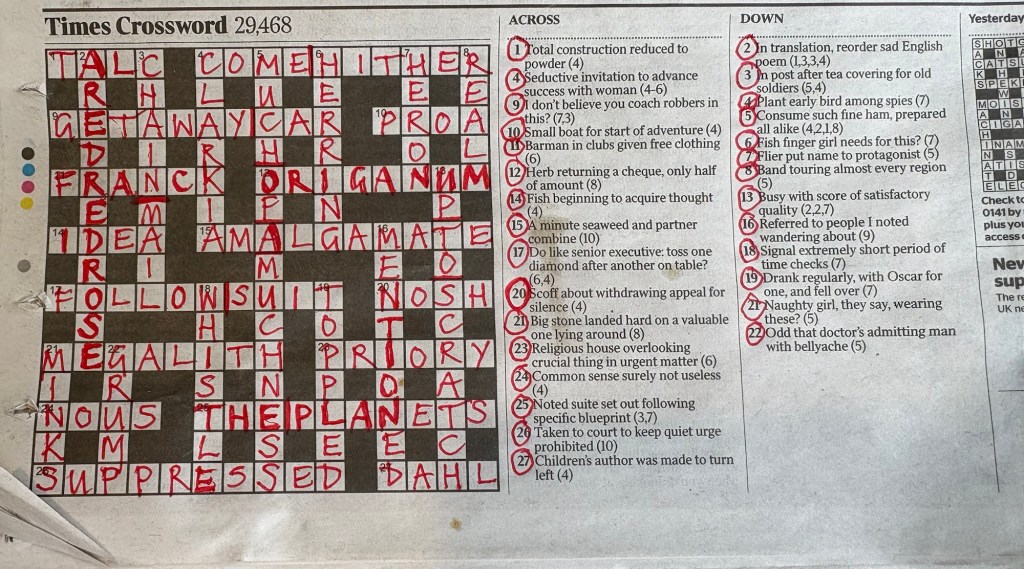
Pleasant
Nomadi, di Alice (Battiato)
Il cielo d’Irlanda, di Fiorella Mannoia
Very enjoyable
Alice, Una notte speciale
Tougher than on a typical Monday, but enjoyable
Very enjoyable
Pleasing
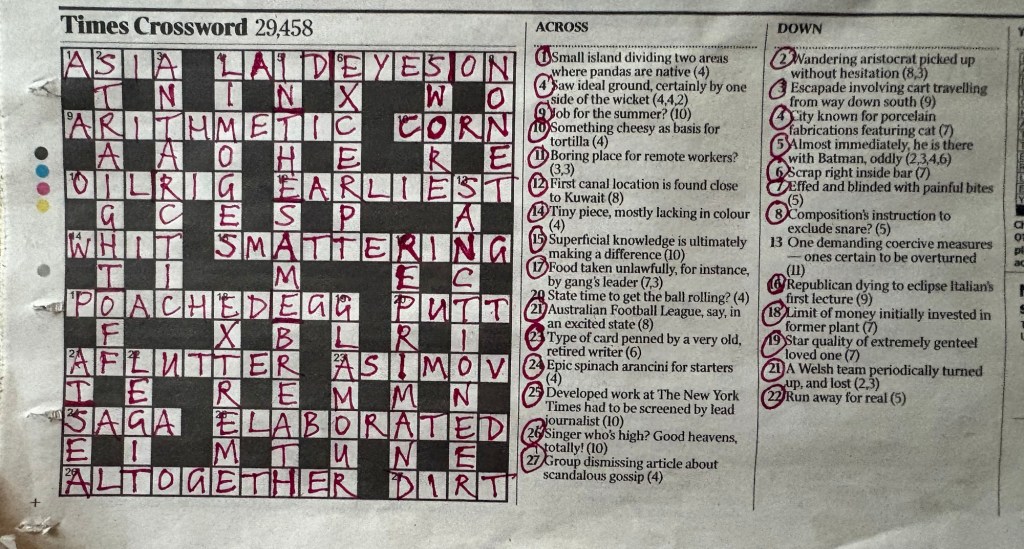
A pleasant puzzle …
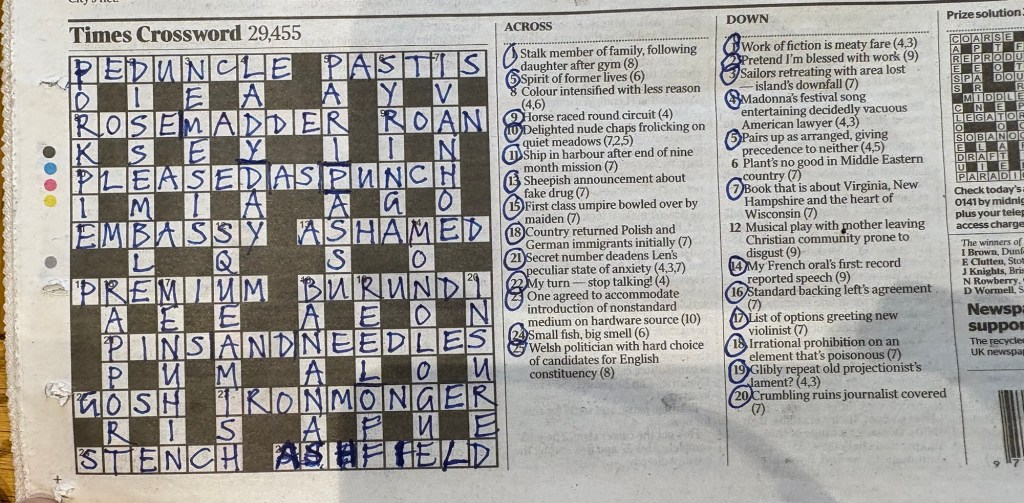
I’d never heard of “Rose Madder”, but it had to be that.
Bellwether
The Melian Dialogue
Internet History Sourcebooks Project: Ancient History
— Read on sourcebooks.web.fordham.edu/ancient/thuc-melian.asp
All but one, « cross-hatch »!
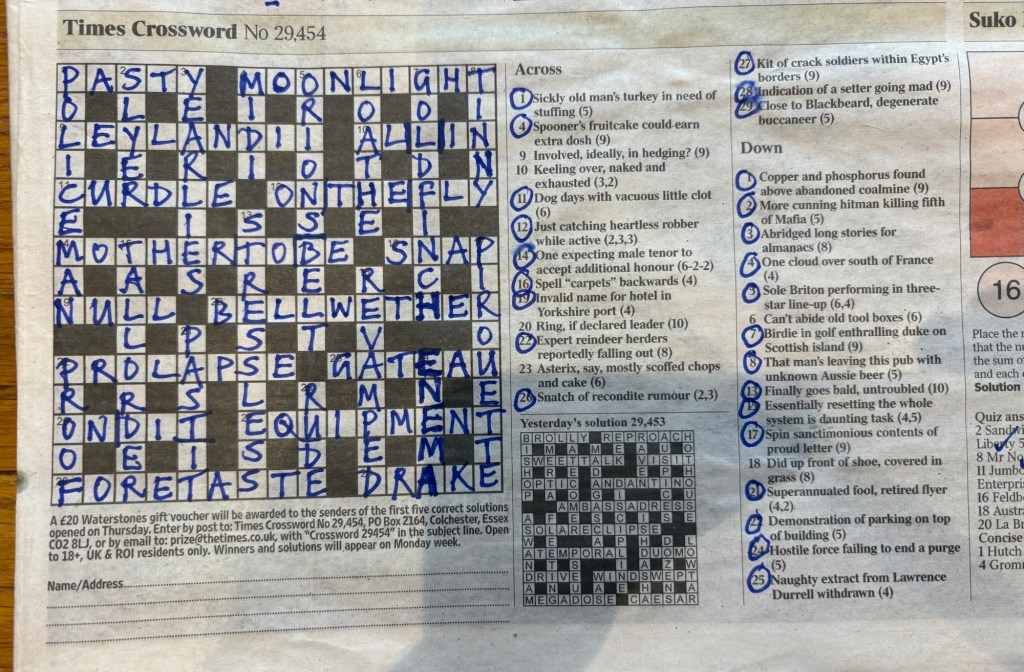
A gentle start to the week

Satisfying
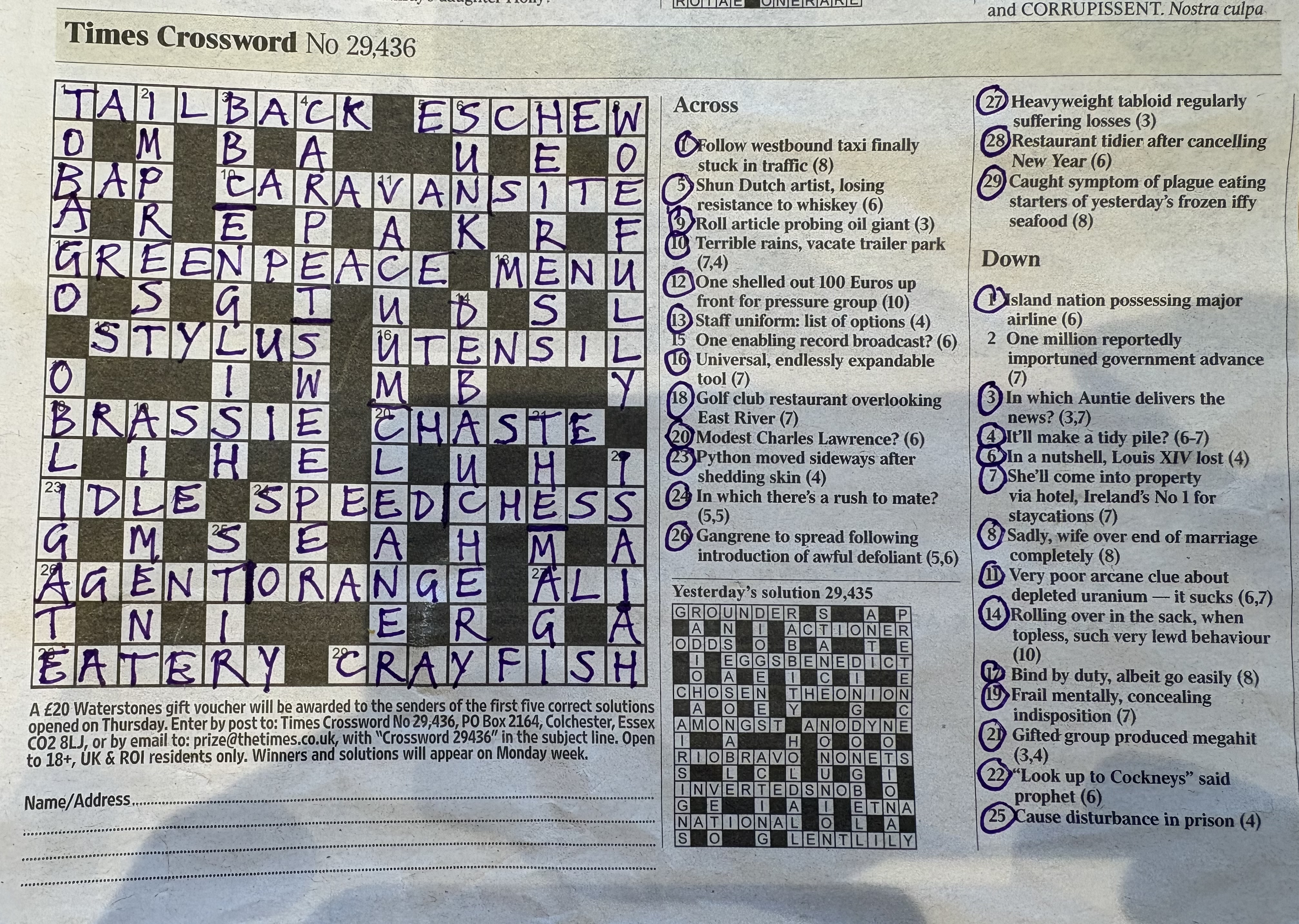
Satisfying
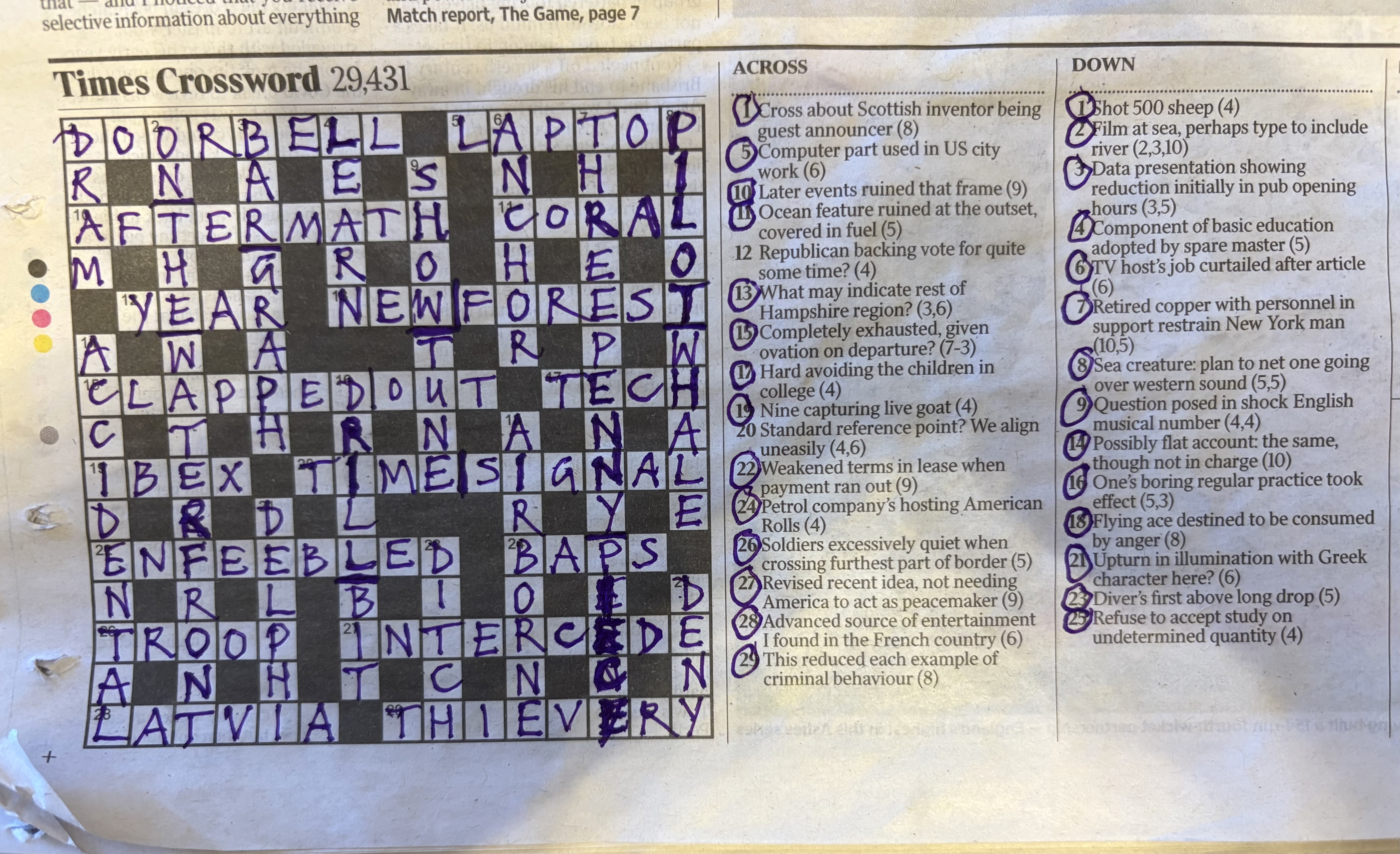
Rosary

David Duckham “Dai for England”
Hypocorism – Wikipedia
— Read on en.wikipedia.org/wiki/Hypocorism
Duckham is perhaps best remembered for his performances for the British and Irish Lions and Barbarians teams under the Welsh coach Carwyn James.[4] James had admired Duckham’s abilities (despite playing in an era when England struggled for consistency and results) and selected him as a winger for the 1971 British Lions tour to New Zealand. Under James’ tutelage, Duckham was given an attacking freedom that he had not experienced with England and this brought the best out of his remarkable talent. Duckham would score 11 tries in his 16 games on the tour, featuring in three tests.[5] Duckham’s six tries in the match against West Coast-Buller set a record for a visiting player in a single match in New Zealand.[6]
In 1973, Duckham was reunited with James and many of his teammates from the 1971 Lions tour, when he was named as the only English back in the Barbarians side to play the All Blacks at Cardiff Arms Park. In the match, Duckham’s counter-attacks broke the All Black’s defence, even wrong-footing a cameraman with one outrageous dummy. The match is remembered as a classic, with the Barbarians winning 23–11. Duckham’s transformation under James, together with his status as the lone Englishman in a backline dominated by Welsh players, would see him became a favourite among both Welsh players and supporters, with many regarding him as one of their own. This earned him the life long nickname Dai (an affectionate Welsh hypocorism of David).[3][4]Duckham would even name his autobiography, Dai for England.[7]
Wordsworth meets Freud
My heart leaps up when I behold
A Rainbow in the sky:
So was it when my life began;
So is it now I am a man;
So be it when I shall grow old,
Or let me die!
The Child is father of the man;
And I wish my days to be
Bound each to each by natural piety. (William Wordsworth)

“Freud’s eternal contribution has been to alert us to the many ways in which adult emotional lives sit on top of childhood experiences and how we are made sick by not knowing our own histories. In a saner world, we would be left in no doubt, and even partially alerted while we were living through them, that our childhoods hold the secrets to our identities. We would know that the one subject we need to excel at, above all, is one not yet flagged up by the school system, the subject called “My Childhood”, and the sign that we have graduated in this topic with honours is when, at last, we can know, and think non-defensively, about how we are, in small ways and large, a little bit mad, and what exactly in the distant past might have made us so.” Alain de Botton (The School of Life)
On the importance of understanding our own childhood.
Ode on Intimations of Immortality from Recollections of Early Childhood
There was a time when meadow, grove, and stream,
The earth, and every common sight
To me did seem
Apparelled in celestial light,
The glory and the freshness of a dream.
It is not now as it hath been of yore;—
Turn wheresoe’er I may,
By night or day,
The things which I have seen I now can see no more.
The rainbow comes and goes,
And lovely is the rose;
The moon doth with delight
Look round her when the heavens are bare;
Waters on a starry night
Are beautiful and fair;
The sunshine is a glorious birth;
But yet I know, where’er I go,
That there hath past away a glory from the earth.
Now, while the birds thus sing a joyous song,
And while the young lambs bound
As to the tabor’s sound,
To me alone there came a thought of grief:
A timely utterance gave that thought relief,
And I again am strong.
The cataracts blow their trumpets from the steep,—
No more shall grief of mine the season wrong:
I hear the echoes through the mountains throng.
The winds come to me from the fields of sleep,
And all the earth is gay;
Land and sea
Give themselves up to jollity,
And with the heart of May
Doth every beast keep holiday;—
Thou child of joy,
Shout round me, let me hear thy shouts, thou happy
Shepherd-boy!
Ye blesséd Creatures, I have heard the call
Ye to each other make; I see
The heavens laugh with you in your jubilee;
My heart is at your festival,
My head hath its coronal,
The fulness of your bliss, I feel—I feel it all.
O evil day! if I were sullen
While Earth herself is adorning
This sweet May-morning;
And the children are culling
On every side
In a thousand valleys far and wide
Fresh flowers; while the sun shines warm,
And the babe leaps up on his mother’s arm:—
I hear, I hear, with joy I hear!
—But there’s a tree, of many, one,
A single field which I have look’d upon,
Both of them speak of something that is gone:
The pansy at my feet
Doth the same tale repeat:
Whither is fled the visionary gleam?
Where is it now, the glory and the dream?
Our birth is but a sleep and a forgetting;
The Soul that rises with us, our life’s Star,
Hath had elsewhere its setting
And cometh from afar;
Not in entire forgetfulness,
And not in utter nakedness,
But trailing clouds of glory do we come
From God, who is our home:
Heaven lies about us in our infancy!
Shades of the prison-house begin to close
Upon the growing Boy,
But he beholds the light, and whence it flows,
He sees it in his joy;
The Youth, who daily farther from the east
Must travel, still is Nature’s priest,
And by the vision splendid
Is on his way attended;
At length the Man perceives it die away,
And fade into the light of common day.
Earth fills her lap with pleasures of her own;
Yearnings she hath in her own natural kind,
And, even with something of a mother’s mind,
And no unworthy aim,
The homely nurse doth all she can
To make her foster-child, her inmate, Man,
Forget the glories he hath known,
And that imperial palace whence he came.
Behold the Child among his new-born blisses,
A six years’ darling of a pigmy size!
See, where ’mid work of his own hand he lies,
Fretted by sallies of his mother’s kisses,
With light upon him from his father’s eyes!
See, at his feet, some little plan or chart,
Some fragment from his dream of human life,
Shaped by himself with newly-learned art;
A wedding or a festival,
A mourning or a funeral;
And this hath now his heart,
And unto this he frames his song:
Then will he fit his tongue
To dialogues of business, love, or strife;
But it will not be long
Ere this be thrown aside,
And with new joy and pride
The little actor cons another part;
Filling from time to time his ‘humorous stage’
With all the Persons, down to palsied Age,
That life brings with her in her equipage;
As if his whole vocation
Were endless imitation.
Thou, whose exterior semblance doth belie
Thy soul’s immensity;
Thou best philosopher, who yet dost keep
Thy heritage, thou eye among the blind,
That, deaf and silent, read’st the eternal deep,
Haunted for ever by the eternal Mind,—
Mighty Prophet! Seer blest!
On whom those truths rest
Which we are toiling all our lives to find,
In darkness lost, the darkness of the grave;
Thou, over whom thy Immortality
Broods like the day, a master o’er a slave,
A Presence which is not to be put by;
To whom the grave
Is but a lonely bed, without the sense of sight
Of day or the warm light,
A place of thoughts where we in waiting lie;
Thou little child, yet glorious in the might
Of heaven-born freedom on thy being’s height,
Why with such earnest pains dost thou provoke
The years to bring the inevitable yoke,
Thus blindly with thy blessedness at strife?
Full soon thy soul shall have her earthly freight,
And custom lie upon thee with a weight
Heavy as frost, and deep almost as life!
O joy! that in our embers
Is something that doth live,
That Nature yet remembers
What was so fugitive!
The thought of our past years in me doth breed
Perpetual benediction: not indeed
For that which is most worthy to be blest,
Delight and liberty, the simple creed
Of Childhood, whether busy or at rest,
With new-fledged hope still fluttering in his breast:—
—Not for these I raise
The song of thanks and praise;
But for those obstinate questionings
Of sense and outward things,
Fallings from us, vanishings,
Blank misgivings of a creature
Moving about in worlds not realized,
High instincts, before which our mortal nature
Did tremble like a guilty thing surprised:
But for those first affections,
Those shadowy recollections,
Which, be they what they may,
Are yet the fountain-light of all our day,
Are yet a master-light of all our seeing;
Uphold us—cherish—and have power to make
Our noisy years seem moments in the being
Of the eternal Silence: truths that wake,
To perish never;
Which neither listlessness, nor mad endeavour,
Nor man nor boy,
Nor all that is at enmity with joy,
Can utterly abolish or destroy!
Hence, in a season of calm weather
Though inland far we be,
Our souls have sight of that immortal sea
Which brought us hither;
Can in a moment travel thither—
And see the children sport upon the shore,
And hear the mighty waters rolling evermore.
Then, sing, ye birds, sing, sing a joyous song!
And let the young lambs bound
As to the tabor’s sound!
We, in thought, will join your throng,
Ye that pipe and ye that play,
Ye that through your hearts to-day
Feel the gladness of the May!
What though the radiance which was once so bright
Be now for ever taken from my sight,
Though nothing can bring back the hour
Of splendour in the grass, of glory in the flower;
We will grieve not, rather find
Strength in what remains behind;
In the primal sympathy
Which having been must ever be;
In the soothing thoughts that spring
Out of human suffering;
In the faith that looks through death,
In years that bring the philosophic mind.
And O, ye Fountains, Meadows, Hills, and Groves,
Forebode not any severing of our loves!
Yet in my heart of hearts I feel your might;
I only have relinquish’d one delight
To live beneath your more habitual sway;
I love the brooks which down their channels fret
Even more than when I tripp’d lightly as they;
The innocent brightness of a new-born day
Is lovely yet;
The clouds that gather round the setting sun
Do take a sober colouring from an eye
That hath kept watch o’er man’s mortality;
Another race hath been, and other palms are won.
Thanks to the human heart by which we live,
Thanks to its tenderness, its joys, and fears,
To me the meanest flower that blows can give
Thoughts that do often lie too deep for tears.
Wordsworth
Another well-pitched puzzle

Another pleasing puzzle

Very pleasant!

Very pleasing, apart from « captcha », at which I stared gormlessly for some time.

Very enjoyable

A very pleasing puzzle, unlike Wednesday’s

Second wind!
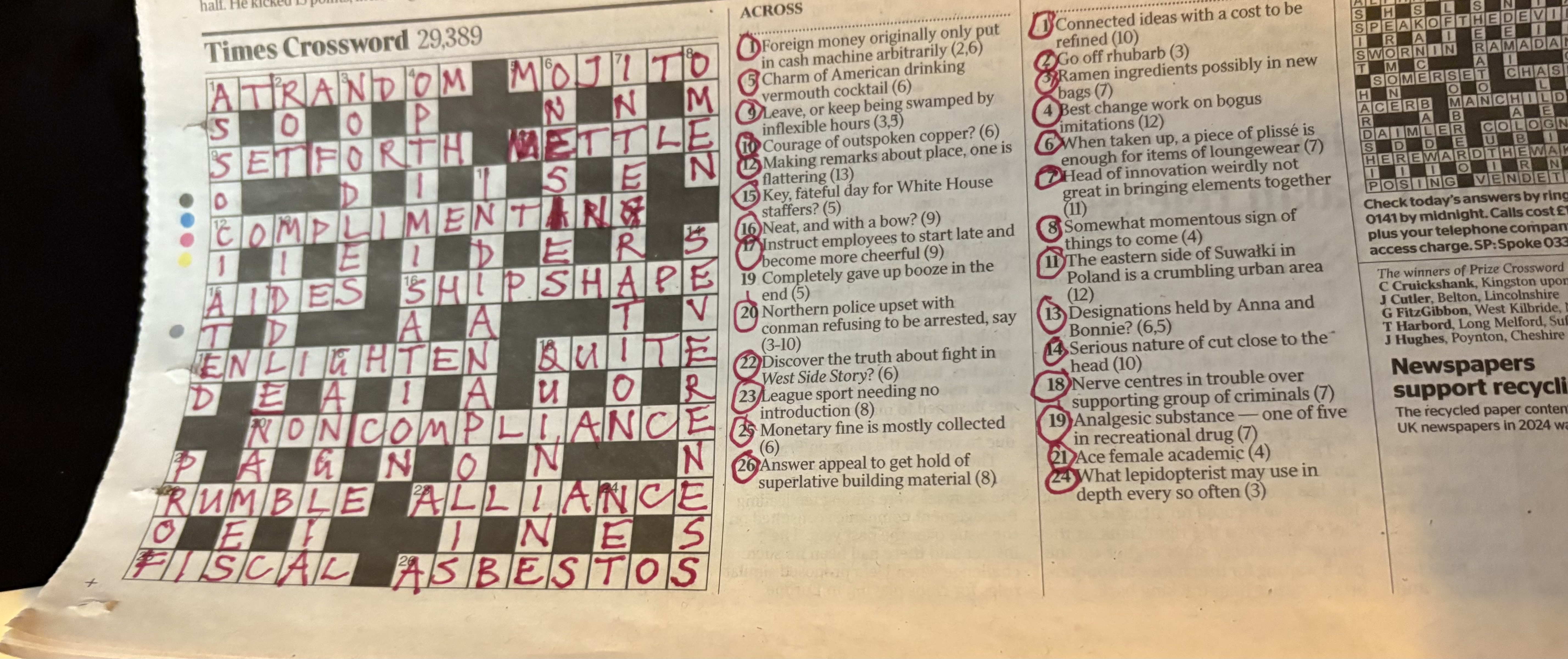
Perfectly pitched, after some nerdy ones this week.
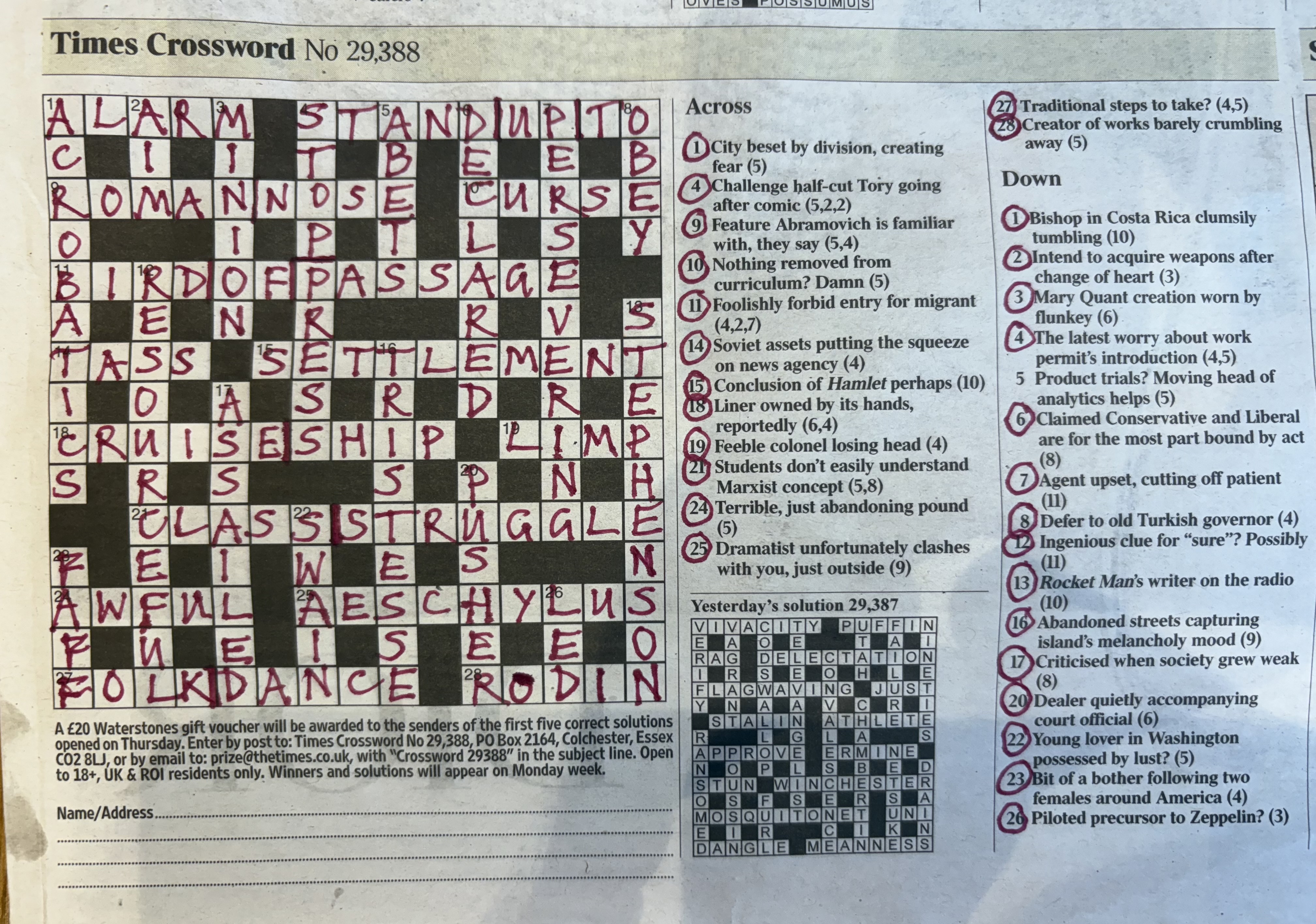
Equator!

Somehow everything slotted into place and made sense.
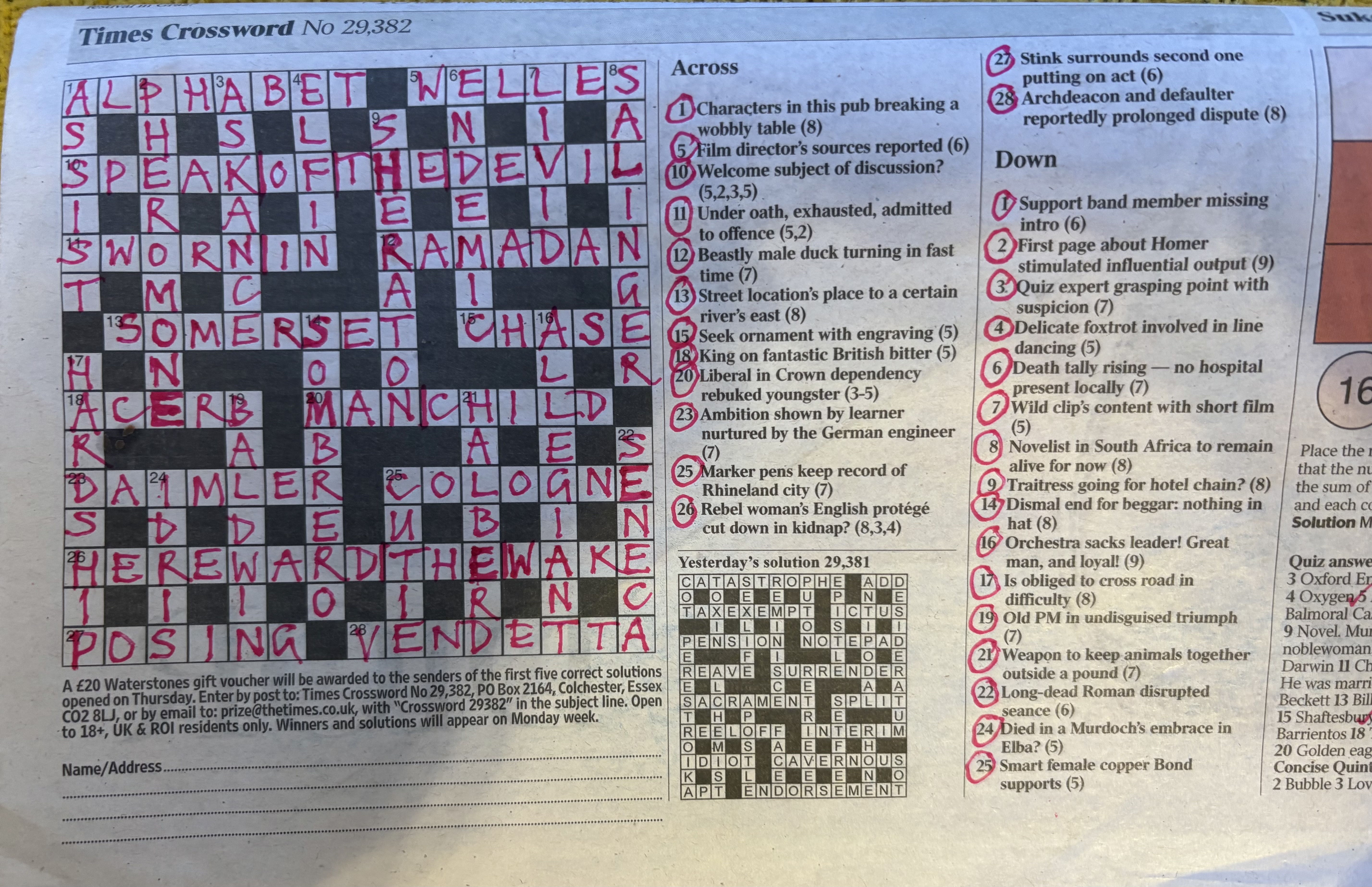
Unsinkable Sam et al. That sinking feline | | The Guardian
Could the introduction of pet passports bring a return of ships’ cats? JD Carpentieri looks back at the moggies who once ruled the waves.
— Read on www.theguardian.com/theguardian/2001/aug/04/weekend7.weekend9
Sapere aude…
Sapere aude: incipe!
qui recte vivendi prorogat horam,
rusticus exspectat dum defluat amnis;
at ille labitur et labetur in omne volubilis aevum.
Enjoyable

… though, bizarrely, “fries” took a while at the end! LJ
Enjoyable
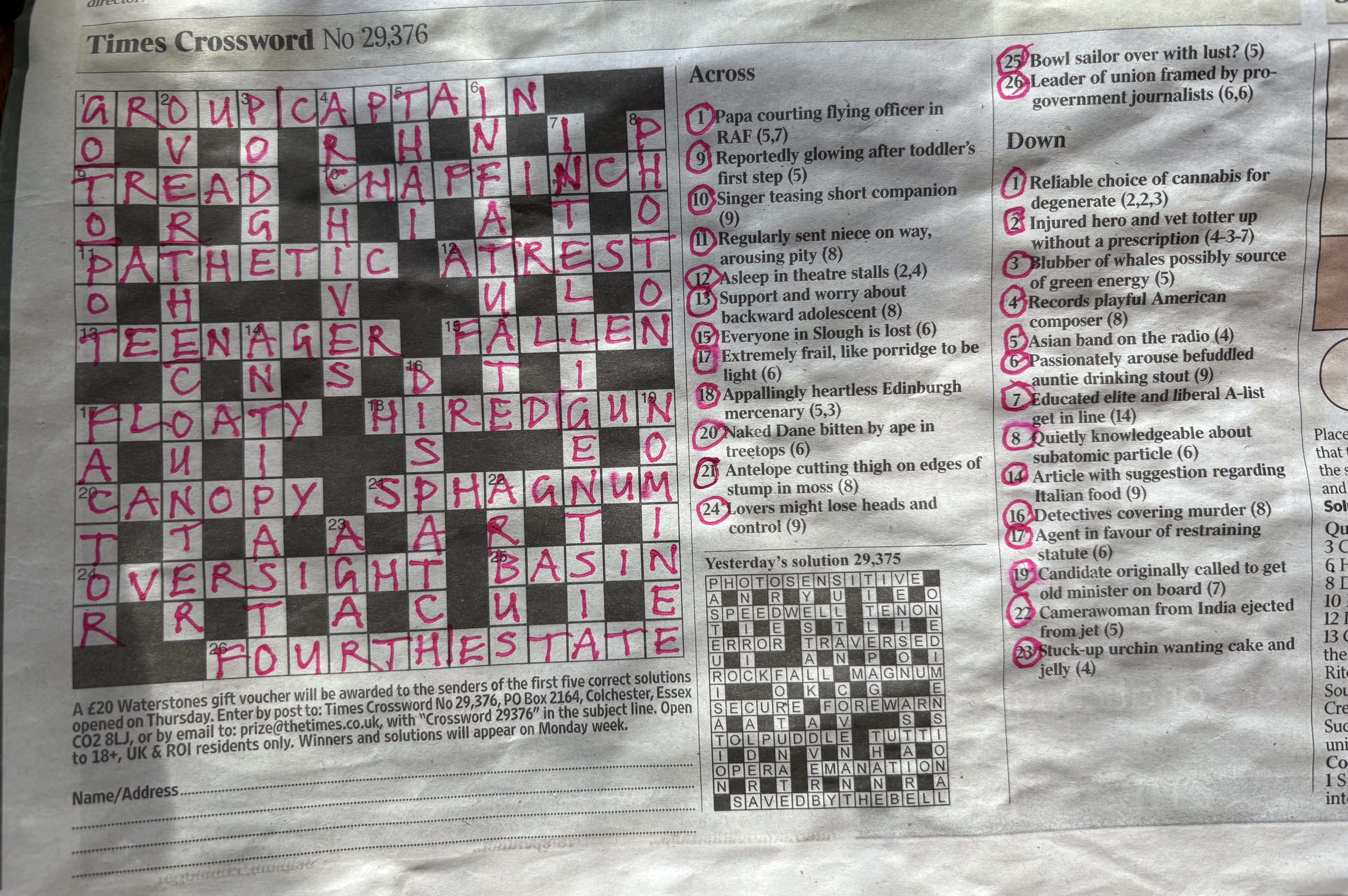
I enjoyed this one!

Quite satisfying

Detonate art …

Fulfilling. I had to dig deep to complete this one.

Thomas Sowell, on his life
One or two challenging clues, but a pleasant puzzle.

Pervasive asset!

As of to-day …
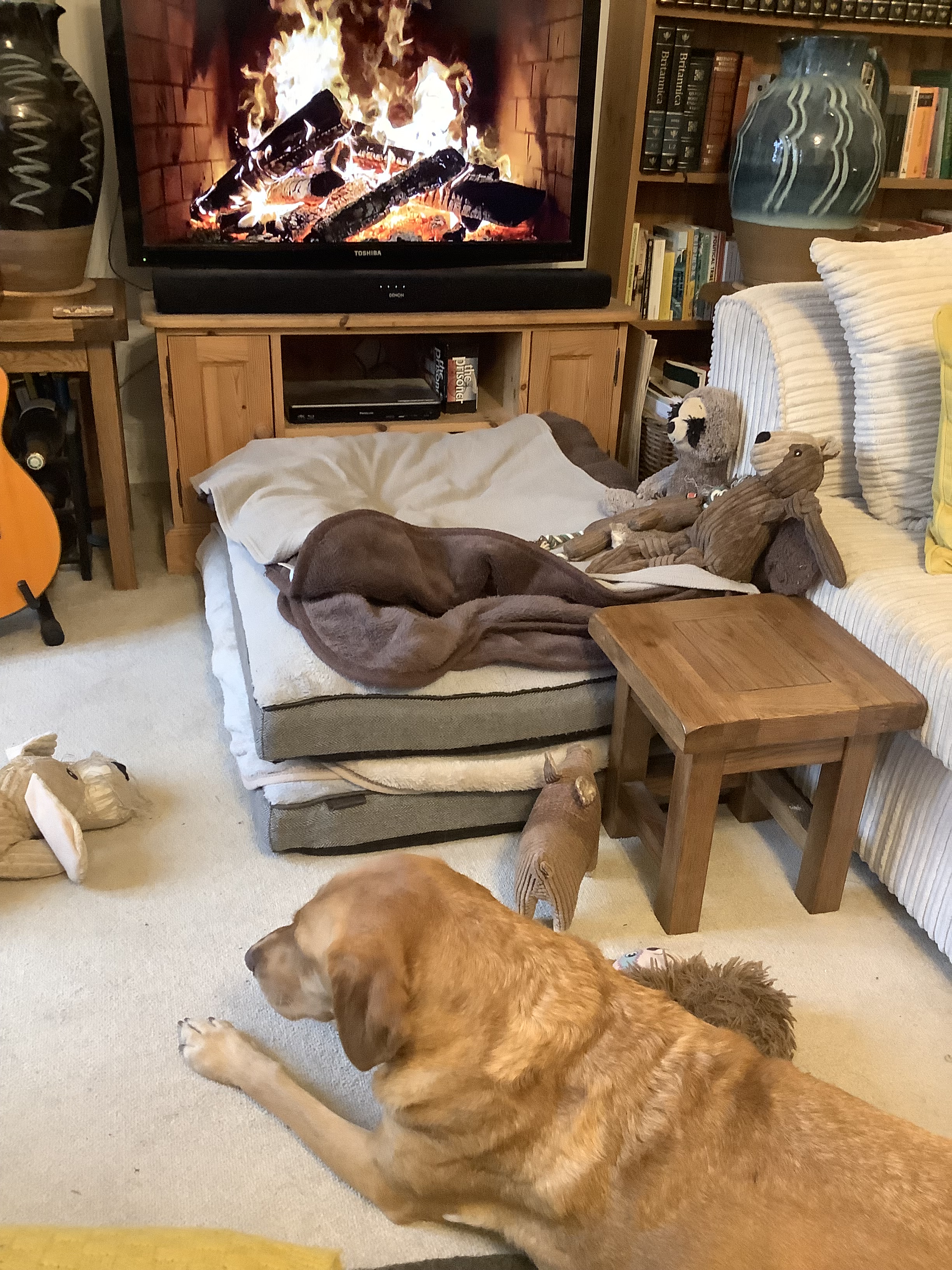
Figgy is registered in my name! 🎩🦮😊
Quite satisfying!

A pleasant puzzle

 Lyndon @ Adonis Blue
You must be logged in to post a comment.